

The Swiss property market: stable, tight and challenging.
19.10.2026How the residential property market will develop in autumn 2026, what this means for exclusive properties, and why expert advice makes all the difference right now.
A market that defies uncertainty
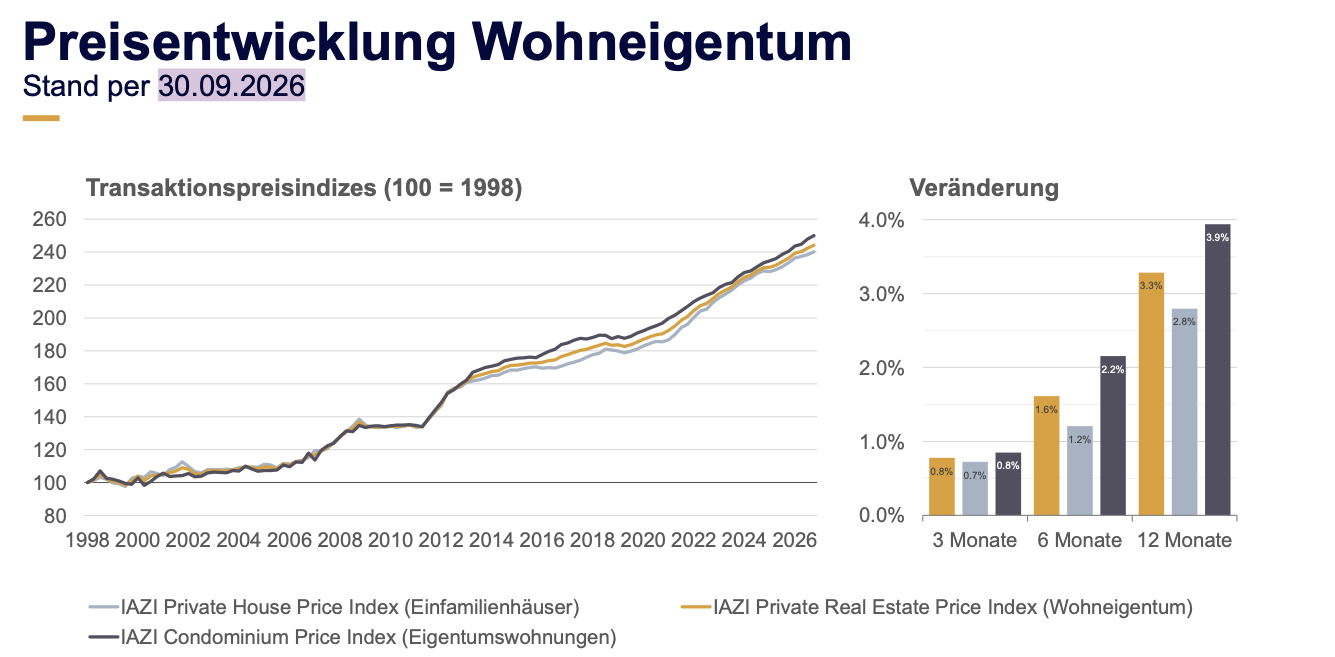
Geopolitical tensions, volatile capital markets, inflation in the euro and dollar zones: the environment is anything but calm. The Swiss residential property market appears remarkably unfazed by this. According to the “IAZI Private Real Estate Price Index”, residential property prices rose by 0.8 per cent in the third quarter of 2026 compared with the previous quarter, and by 3.9 per cent year-on-year. The figures are based on actual over-the-counter transactions – that is, on prices actually paid rather than asking prices.
Two indices, one finding
The Raiffeisen Transaction Price Index paints an even more dynamic picture: detached houses rose in price by 2.0 per cent in the third quarter, whilst flats rose by 1.7 per cent. Compared with the previous year, the increase for detached houses stands at 3.6 per cent, and for flats as much as 5.9 per cent. The figures from the two surveys differ in detail, due to differences in methodology, data sources and weighting. However, the trend is clear: prices are continuing to rise. However, according to the IAZI, the momentum has slowed slightly compared with previous quarters, and both the number of transactions and the growth in mortgage volumes are down slightly.
Scarce supply remains the decisive factor
The main reason for the sustained strength in prices is scarcity. The nationwide vacancy rate fell for the sixth consecutive time as at 1 June 2026 and stands at 0.9 per cent. Of the approximately 45,000 vacant residential units, just under 11,000 are owner-occupied homes. Housing construction remains subdued, and even the slight decline in immigration is not noticeably easing the situation. Raiffeisen’s chief economist, Fredy Hasenmaile, emphasises that the moderate rise in interest rates on fixed-rate mortgages is not enough to break the price trend, because supply simply remains too low.
Interest rates: Low key rates, but a watchful eye on the future
On 24 September 2026, the Swiss National Bank left the key interest rate at 0 per cent. Ten-year fixed-rate mortgages stand at around 2 per cent, whilst money market mortgages based on SARON are just over 1 per cent. Due to moderate domestic inflation, the SNB is under no immediate pressure to act. However, the prospect of a possible end to the zero-interest-rate regime has already pushed up the cost of fixed-rate mortgages in recent months. If long-term capital market interest rates continue to rise, this could also affect Swiss mortgage terms. At the same time, banks are adopting a more selective approach to financing that is barely affordable.
Regions and locations: Where prices are rising the most
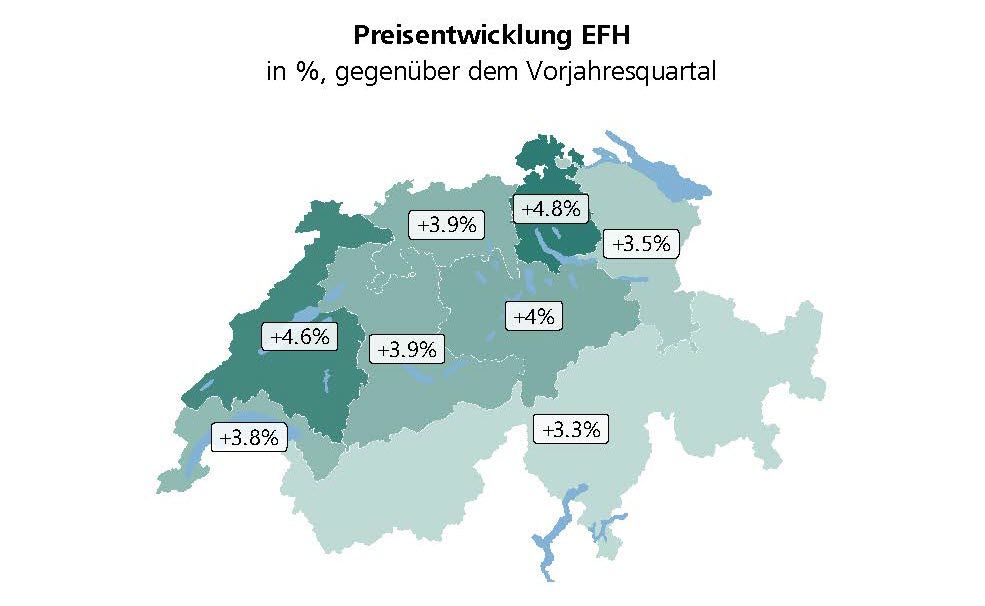
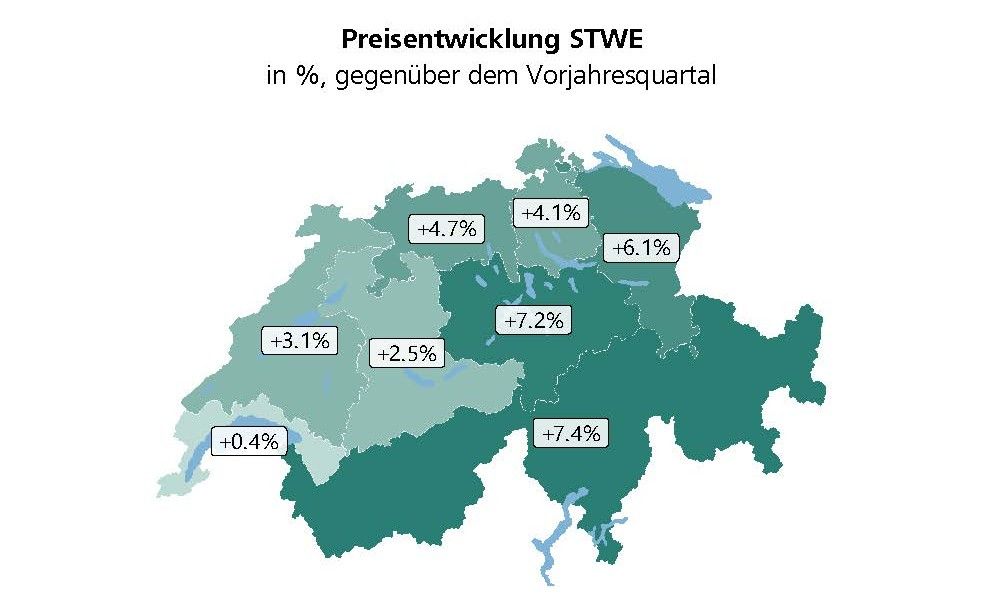
Year-on-year, detached houses saw the sharpest rises in Zurich (+4.8 per cent) and in Western Switzerland (+4.6 per cent), whilst increases were slightly lower in Eastern Switzerland (+3.5 per cent) and Southern Switzerland (+3.3 per cent). When viewed by municipality type, houses in central municipalities saw the sharpest price rises (+5.2 per cent). As regards owner-occupied flats, Southern Switzerland stands out with a rise of +7.4 per cent, whilst the Lake Geneva region, at +0.4 per cent, is in contrast very subdued. Condominium prices rose particularly sharply in tourist municipalities (+7.9 per cent), whilst city centres saw the smallest increase at +1.6 per cent. The market is therefore not a uniform entity, but a mosaic of very different sub-markets.
Exclusive property: scarcity as a value anchor
The indices presented here reflect the overall market, not the luxury segment in particular. However, the driving factors can also be identified there. Where building land is scarce and planning permission is a lengthy process – such as in prime lakeside locations, in Zurich’s municipalities or in mountain resorts – the scarcity of supply has a particularly strong impact. The sharp rises in prices for flats in tourist municipalities and for houses around Zurich are consistent with this observation. Furthermore, those who buy exclusive properties are usually less dependent on financing costs, but seek substance, stability and discretion. In uncertain times, Swiss residential property is regarded as a tangible asset with high value stability. At the same time, the pool of suitable properties is limited, and each one is unique.
Outlook: Little change as long as the underlying conditions hold
As long as interest rate policy does not change course and the economic outlook does not deteriorate significantly, the fundamentals are unlikely to change much: tight supply, stable demand, and slightly easing momentum. Risks lie in rising capital market interest rates, stricter lending conditions and affordability, which is becoming a hurdle for many prospective buyers.
Pressure also remains high for investment properties: according to the IAZI, prices for multi-family houses and mixed-use properties rose by 1.4 per cent over the quarter and by 4.5 per cent year-on-year.
Why an experienced estate agency makes all the difference right now
For these reasons, engaging a competent and experienced estate agency with a broad regional presence makes all the difference when buying or selling a property:
- Pricing at the right moment.Markets vary greatly from region to region and depending on the segment. A price set too high deters prospective buyers, whilst one set too low amounts to giving the property away. Those who know the actual transaction prices and are firmly rooted in the local market can provide a realistic valuation.
- Access to the right prospective buyers. With a tight supply and, at the same time, more selective lending, what counts is knowing buyers who are solvent and determined. An established network saves time and prevents setbacks.
- Discretion and professional marketing.Exclusive properties are often marketed discreetly, without wide distribution. This requires experience, tact and the right channels.
- Keeping an eye on financing and market conditions.Interest rate trends, SARON or fixed-rate mortgages, affordability: Particularly when interest rate expectations are shifting, it is worth seeking expert analysis and collaborating with the right financial partners.
- Negotiating strength and security.From the viewing through the negotiations to the appointment with the solicitor: anyone who guides you through the purchase or sale of a property protects you from legal and financial pitfalls.
In a market where value and scarcity converge, the quality of the advice determines the outcome. We would be delighted to guide you through this process – personally, competently and discreetly.