
Where life is best.
15.09.2026With its ‘Residential Attractiveness Indicator 2026’ (WAI) UBS has analysed over 2,000 Swiss municipalities based on 38 criteria and ranked them regionally. Whilst the study focuses on middle-income families, the separate analysis for high-income households provides valuable insights for owners and buyers of properties in the upmarket segment – ranging from tax benefits to which municipalities are likely to see an increase in value in the future.
Regional comparison rather than a national ranking
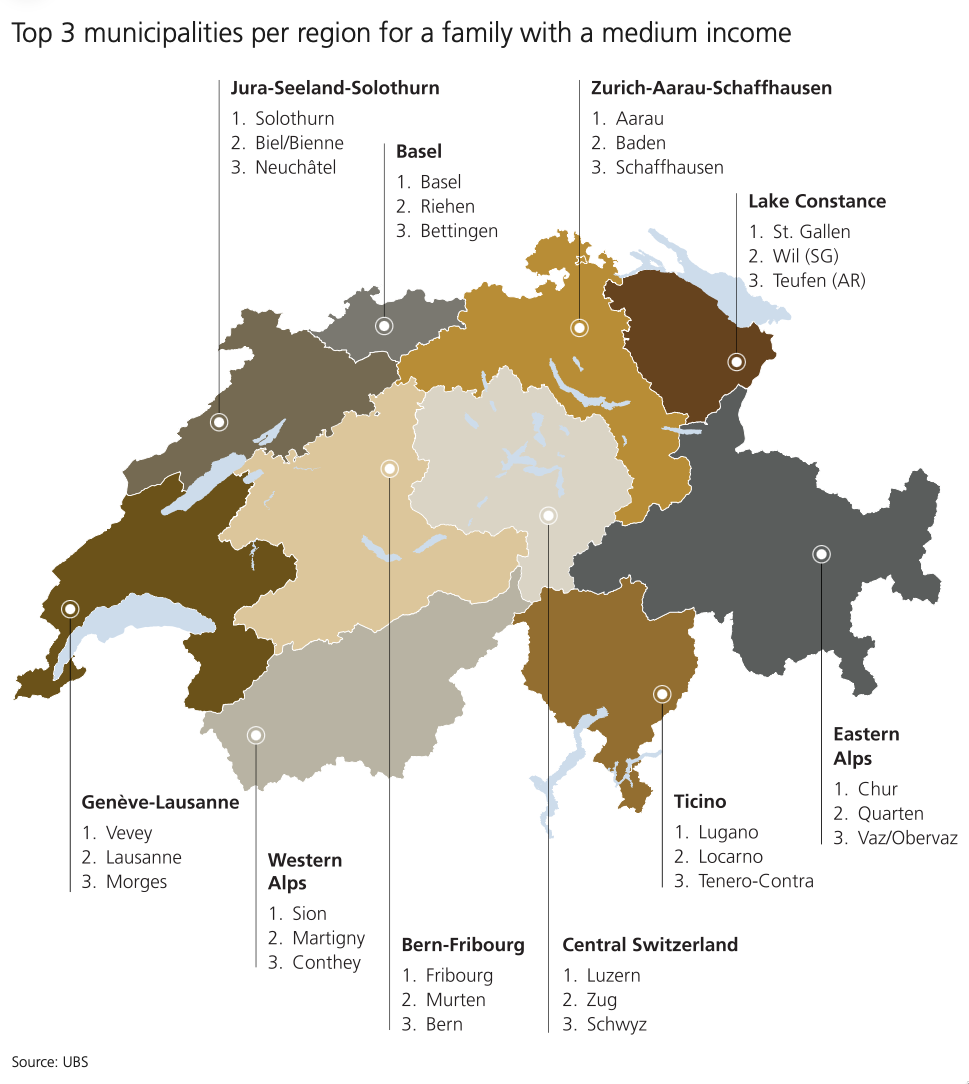
The study does not compare municipalities across the whole of Switzerland, but within ten labour market regions – as around 70 per cent of all house moves take place within a radius of less than ten kilometres. For the high-end property market, this means: Anyone looking for or owning a property in the Zurich-Aarau-Schaffhausen region should focus on the local frontrunners rather than on national city rankings. The assessment is based on three pillars: infrastructure and accessibility, leisure and quality of life, and costs – for high-income households, tax benefits carry particular weight, more so than for lower income groups.
The top destinations for discerning tastes
In the Zurich-Aarau-Schaffhausen region, Freienbach, Lachen and Rapperswil-Jona top the list for high-income households, followed by Zurich itself and the ‘Gold Coast’ municipalities of Rüschlikon, Zollikon and Kilchberg. In Central Switzerland, Lucerne, Zug and Schwyz dominate, whilst in the Eastern Alps, alongside Chur, St. Moritz, Laax and Davos also feature in the top ten for high earners. In the Lake Geneva region, a similar picture emerges of established locations, with Vevey, Collonge-Bellerive and Geneva. This analysis largely coincides with the well-known locations in the Swiss luxury property market – but confirms them using a broad, objective database.
Why tax burden and centrality are the deciding factors
The study shows that, for high-net-worth households, the tax burden in particular plays a key role in the choice of location, whilst accessibility, educational and healthcare provision, and the quality of leisure facilities make up the rest of the appeal. Particularly revealing for owners and buyers: Only a handful of municipalities combine above-average infrastructure with below-average living costs – most attractive locations pay for their locational advantages with correspondingly high costs. Anyone who owns or acquires a property in the upmarket segment is therefore not only investing in location and amenities, but also, in effect, in this interplay of tax revenue, accessibility and quality of life, which underpins the long-term value retention of a property.
You can download the full study as a PDF here.
Relevance for sellers and buyers
For sellers, the indicator provides an additional selling point: If a property is situated in a municipality deemed particularly attractive according to the WAI, this can be objectively substantiated by an independent study – a selling point when dealing with prospective buyers who are not familiar with the location from personal experience. Buyers, in turn, are provided with a tool in the form of UBS’s free municipal guide to examine individual municipalities in greater depth – from the tax burden to the trend in house prices. Particularly when it comes to second homes in alpine regions or when moving away from urban centres, regional comparisons can help identify the municipality with the best value for money from among several attractive options.
Availability trumps wish lists
However insightful the residential attractiveness indicator may be, it applies to a Swiss property market where supply has remained tight for years, particularly in the upmarket segment. Attractive municipalities such as Zollikon, Küsnacht, Zug and St. Moritz consequently record few property sales per year, and suitable properties often do not even come onto the open market in the first place. In this situation, the deciding factor is often not so much the theoretically ideal municipality as the question of whether and when a suitable property will become available at all – and whether one finds out about it in time. Valuable rankings and data sets such as the WAI therefore remain a useful guide, but they are no substitute for practical, on-the-ground market knowledge.
Why a locally based estate agent pays off
This is precisely where the value of a well-connected, locally based estate agent becomes apparent. Those who have known the market in a particular region for years often hear of intentions to sell before a property is publicly advertised, and can bring buyers and sellers together at an early stage. For sellers, this means access to a pool of pre-qualified, financially sound prospective buyers and discreet marketing that does justice to the property’s exclusive nature. For buyers, in turn, this opens up access to properties they would never have found through an online search alone. Precisely because objective studies such as the Residential Attractiveness Indicator show how closely attractive location, tax benefits and quality of life are linked, it is worth combining these insights with the market expertise and network of an experienced estate agent – because, ultimately, it is often a question of who is in the right place at the right time.