
Hoarding building land is more profitable than building.
26.02.2026The latest publication by Raiffeisen Switzerland on the property market identifies a significant misalignment in the Swiss spatial planning regime. Due to a lack of legal incentives and above-average expected returns on undeveloped plots, the existing potential for densification remains untapped. This leads to artificial scarcity, which massively increases the barriers to entry for home ownership and prevents a socially acceptable solution to the housing shortage.
Financial advantages of hoarding building land and the consequences
The economic logic of land use has become disconnected over the last 25 years. According to Raiffeisen chief economist Fredy Hasenmaile, simply holding on to building land generated a cumulative return of 592%. In direct comparison, the construction and management of an apartment building, including appreciation in value, yielded only 400% – and that with higher risks.
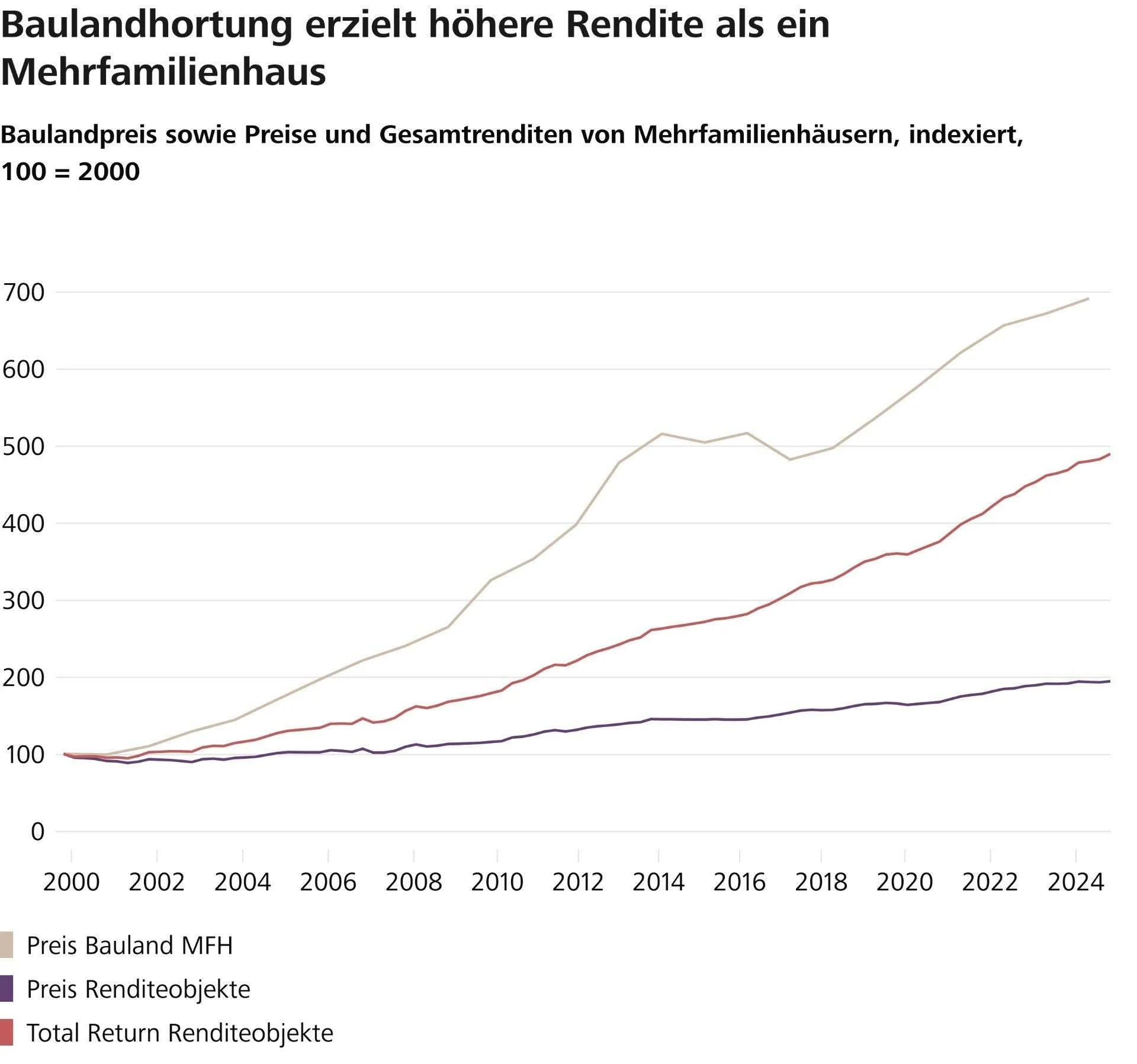
Such differences in returns make it economically sensible not to build, but they are counterproductive from an economic perspective. Currently, between 9.0% and 16.7% of Swiss residential building zones are undeveloped – a reserve that could theoretically provide housing for up to 1.5 million people. The massive outperformance of undeveloped land compared to actively managed real estate or the stock market explains the low mobilisation rate on the Swiss market.
Structural obstacles and qualitative deficiencies
However, the usability of this building land is limited. The example of the canton of Zurich shows that around a quarter of the reserves are not yet ready for construction. In addition, topographical restrictions, natural hazards or inadequate public transport links reduce the real usability of many plots. The result is an extremely low mobilisation rate: in the canton of Zurich, only around 3% of undeveloped land was actually used for construction each year.
The consequences for the owner-occupied housing market: the savings rate is losing out to price dynamics
For private households, buying residential property will become even more difficult in 2025. The nominal price increases – an average of CHF 36,000 for condominiums and CHF 55,000 for single-family homes – significantly exceed the average savings capacity of the population. Whereas in 2010 a young household needed around 10 years to save the necessary equity for a single-family home, this figure has now risen to 28 years.
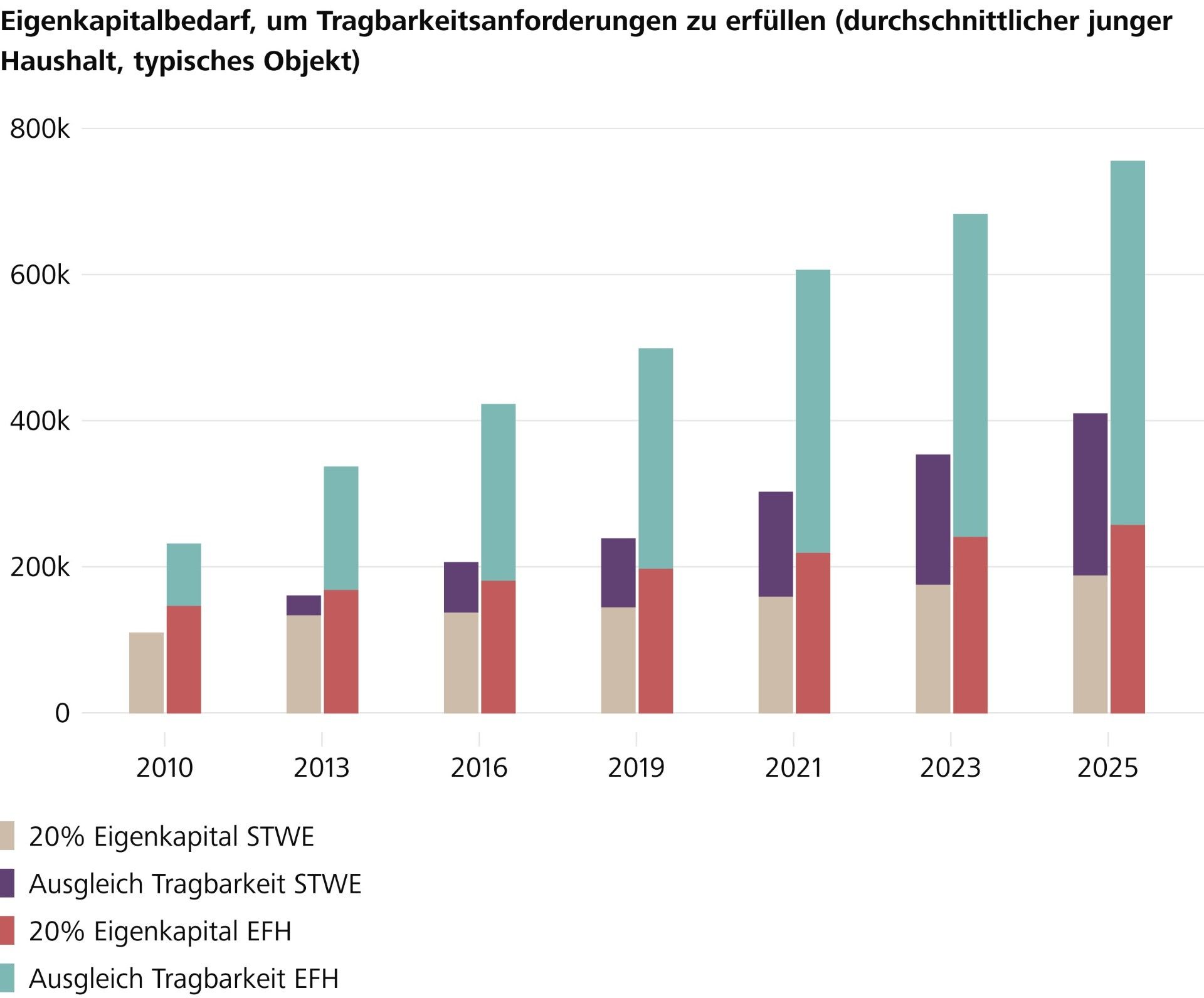
The applicable affordability rules are also proving to be a complicating factor. The discrepancy between stagnating real wages and rising lending requirements means that, despite a high level of discipline, the savings target is becoming practically unattainable for many market participants.
Short-term sideways movement in rents is likely
While the momentum of asking rents has slowed noticeably in 2025 due to temporarily lower immigration and declining domestic demand for housing as a result of sharply rising rents, the fundamental shortage remains.
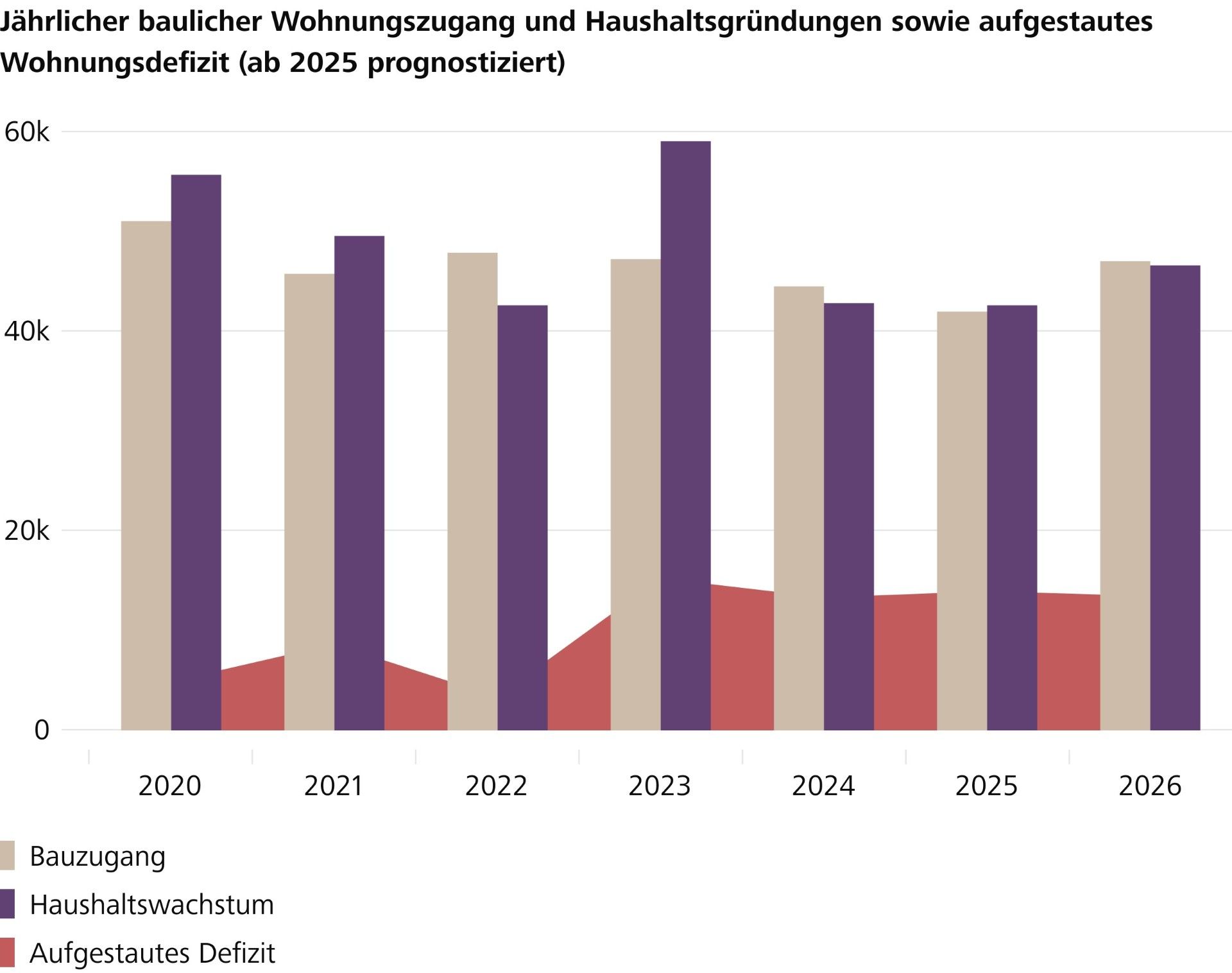
‘In the medium to long term, deficits are likely to reappear, as the number of building applications already indicates that construction activity is structurally far too low. The shortage in the rental housing market and the upward pressure on rents are therefore likely to continue,’ explains Fredy Hasenmaile, Chief Economist at Raiffeisen Switzerland.
Experts from Wüest Partner (Immo-Monitoring 2026) and Zürcher Kantonalbank (ZKB Real Estate Barometer) also support Raiffeisen’s assessment: the number of building permits remains at a historically low level. As housing production is not keeping pace with household growth in the long term, a renewed increase in rental pressure is to be expected in the medium term. Further current statistics on vacancy rates and the rental price index are also provided by the Federal Office for Housing (BWO).
Despite the shortage, we always have attractive offers of undeveloped land for single-family or multi-family homes. We advise you on the purchase from the initial exposé to the handover of the keys. Get in touch with us.