
Swiss property remains the safest investment.
20.04.2026Whilst geopolitical upheavals and economic uncertainties keep global markets on tenterhooks, Switzerland is once again proving its exceptional standing. Current data shows that home ownership in the premium segment is far more than just a home – it is the ultimate anchor of stability in turbulent times.
Anyone looking beyond the country’s borders these days sees a picture of volatility. Trade conflicts, the turmoil of war and economic concerns in Europe are putting pressure on traditional asset classes. Financial specialists do not even trust the current stock market rally, given the ongoing uncertainties surrounding the war in Iran. Yet amidst this ‘global storm’, one market remains remarkably unfazed: the Swiss property market. For owners and prospective buyers of luxury properties, current developments underscore that value retention and discretion remain the Swiss Confederation’s strongest assets.
Value stability and price growth characterise the market
The latest figures from the “IAZI Private Real Estate Price Index” speak for themselves. Despite the complex global situation, willingness to pay for residential property continued to rise in the first quarter of 2026. With a 0.4% increase compared to the previous quarter, the property market continues its moderate but steady upward trend. The picture for the year as a whole is particularly impressive: detached houses rose by 3.5%, whilst owner-occupied flats recorded an increase of 3.7%.
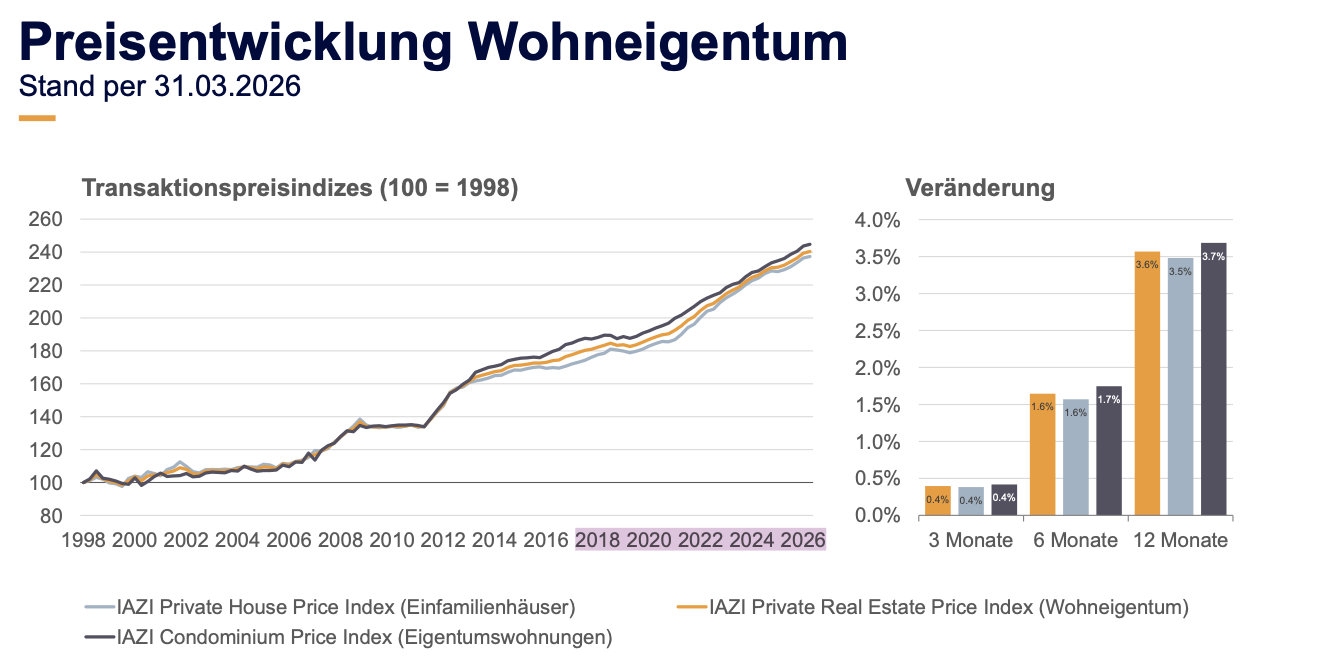
For the discerning investor, the analyses by IAZI AG mean this: property is a reliable store of value that delivers precisely when other markets are fluctuating. In an environment where security has become the highest priority, Swiss property becomes the physical manifestation of economic resilience.
Focus on investment properties: quality beats volume
A clear picture emerges not only in the private residential property sector, but also in the investment property sector.
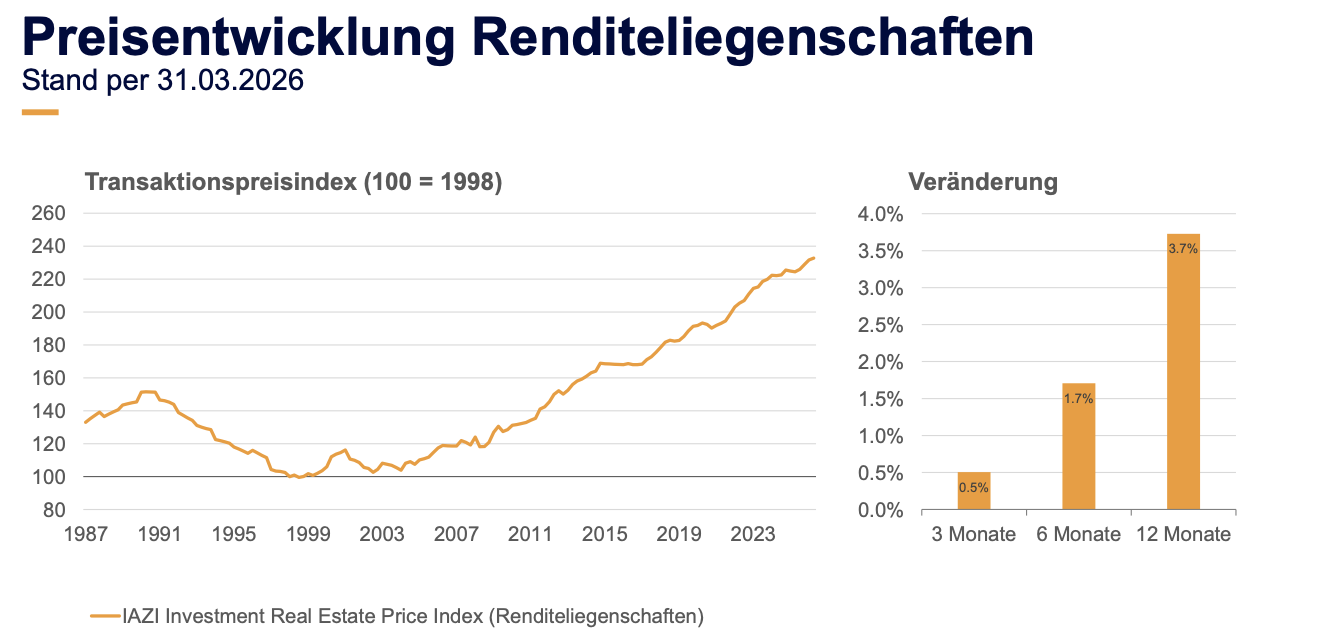
Multi-family homes and mixed-use properties gained 3.7% in value year-on-year. What is interesting here is the strategic shift: the era of quick purchases has given way to a phase of qualitative growth.
Investors are now acting more selectively than ever. The focus is on:
- Prime micro-locations: Location quality remains the most important criterion.
- Sustainable profitability: Properties with long-term potential for value appreciation.
- System stability: Whilst the conservative financing policies of Swiss banks have a dampening effect on the pace of growth, they ensure a healthy, crisis-resistant foundation without the risk of bubbles.
The paradox of scarcity: Why supply remains the driver of prices
A key reason for the unbroken price momentum, which is also highlighted in the ZKB’s latest property barometer (in German language only), lies in structural scarcity. Whilst demand – driven by immigration and the desire for security – remains stable, supply is reaching its limits. In sought-after locations around Switzerland’s lakes or in urban centres, hardly any new residential properties are being built. The ZKB writes: “Zurich’s housing market has made a robust start to the new year with a 1 per cent increase. This brings year-on-year price growth to +2.8 per cent.”
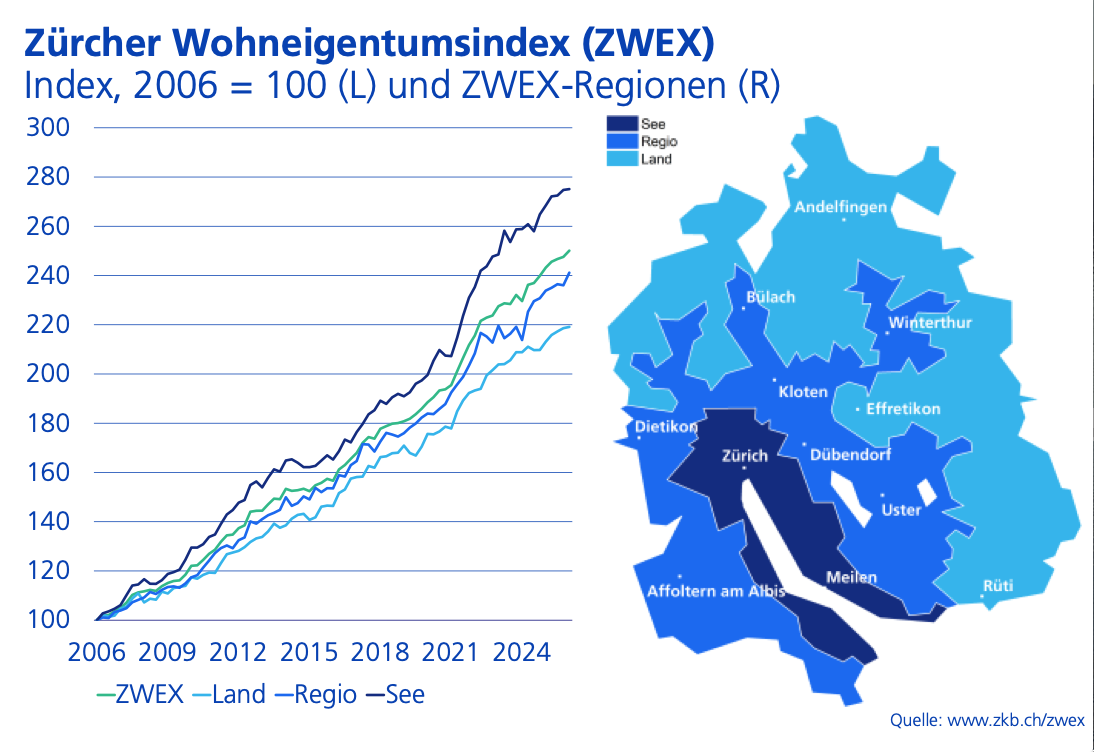
The ZKB’s analysis makes it clear: the market for residential property has “dried up”. As many owners are holding onto their properties due to a lack of alternative investment options, too few properties are coming onto the open market. For prospective buyers in the upmarket segment, this means that in-depth knowledge of the property market, speed and an excellent network are more crucial than ever – because quality has become a rare commodity in Switzerland.
The ‘safe haven’ effect and the interest rate question
A key factor in the market’s continued appeal is the actions of the Swiss National Bank (SNB). Whilst inflation remains a global concern – and is gaining further significance due to the closure of the Strait of Hormuz – the strong Swiss franc acts as a shield, making imported goods cheaper and dampening inflationary pressure. Experts such as Prof. Dr Donato Scognamiglio emphasise that, compared to government bonds, property has become vastly more attractive due to its stable returns.
Although the weakening industrial economy in Germany and potential US tariffs are slightly clouding the general economic outlook, for the property market this paradoxically often means a flight to tangible assets. Should the economy come under further pressure, a return to even more attractive interest rates or even negative interest rates could become a possibility in order to support exports – a scenario that would further fuel demand for exclusive properties.
Is it even possible to go wrong when buying?
This provocative question from the NZZ (link to German article behind paywall) strikes at the heart of current market psychology. With one record price chasing another, many wealthy individuals are wondering when the best time to buy is. However, a look back at history shows that anyone in Switzerland who has waited for a massive price crash has almost always been disappointed in recent decades.
But caution is advised: the NZZ warns against completely ignoring the risks. Even though the long-term trend is upwards, the market is becoming increasingly segmented. Anyone buying today should no longer rely on ‘blind’ growth, but rather on properties that remain compelling due to their uniqueness and energy efficiency, even in the event of a potential sideways movement in prices. A luxury property today is not merely an investment property, but a hedge against inflation – provided the property’s specific characteristics are right.
Psychology trumps forecast: Home ownership as an emotional anchor
An interesting aspect highlighted by current reports is the emotional value of home ownership in times of crisis. In a world of digital assets and volatile stock markets, owning a property offers a physical tangibility that cannot be replaced by any other asset class.
This “psychological return” – that is, the utility and sense of security within one’s own four walls – is a key factor in why willingness to pay remains high even at record prices. In 2026, property ownership in Switzerland is, more than ever, a commitment to continuity and quality of life.
Conclusion for property owners and potential buyers
The message for spring 2026 is clear: the combination of limited supply in prime locations, a stable currency and a prudent monetary policy makes Switzerland the safest haven for property assets worldwide. Anyone investing in or owning a premium property today benefits from value stability that is hardly shaken by short-term market fluctuations.
In times of uncertainty, confidence in the “concrete franc” is more justified than ever. The Swiss property market not only weather the storms – it offers the assurance that you can ride them out in complete peace of mind.
Avoid potential risks and find out about particularly attractive off-market deals. Request a confidential consultation.