

Good market prospects for exclusive properties.
13.08.2026Following an exceptionally dynamic 2025, the Swiss residential property market appears somewhat calmer at the start of the current year – though it remains at a high level. Low interest rates, a structural shortage of supply and the forthcoming abolition of the imputed rental value continue to point towards rising prices, whilst the commercial property market is showing a mixed picture between office and retail space. An in-depth look at the latest assessments from UBS and Wüest Partner – with a particular focus on what buyers and sellers in the upmarket segment need to know right now.
Solid but subdued economic fundamentals
Wüest Partner forecasts moderate real economic growth of 1.1 per cent for 2026, meaning growth momentum remains below the ten-year average of 1.9 per cent. Growth is being held back in particular by geopolitical and geo-economic developments, as well as the Swiss franc, which remains strongly valued – the escalation in the Middle East has also led to a significant rise in international energy prices since the beginning of March
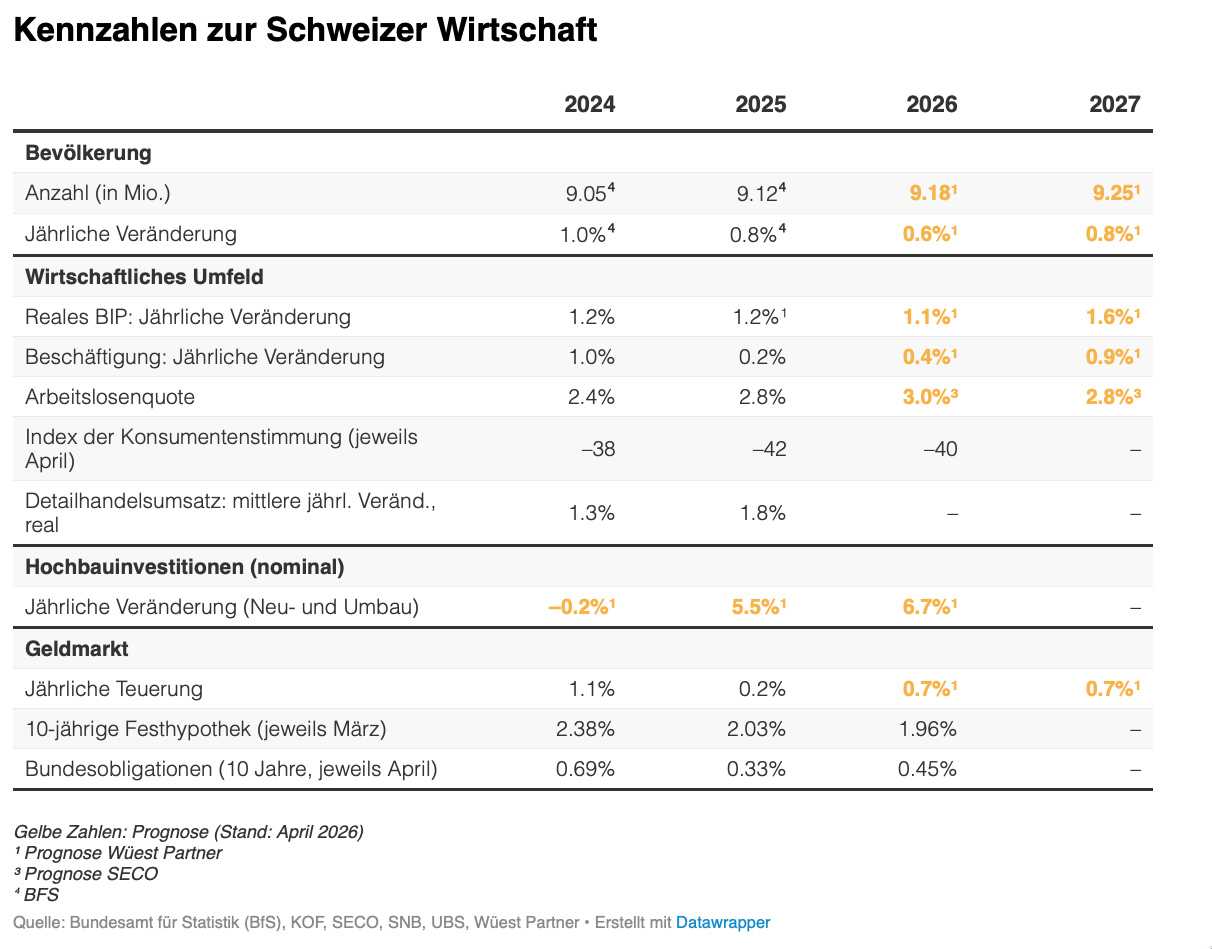
The labour market is also cooling: following employment growth of just 0.2 per cent in the previous year, a moderate increase of 0.4 per cent is expected for 2026, partly because efficiency gains resulting from the increased use of artificial intelligence are slowing the creation of new jobs. Accordingly, with below-average population growth of 0.6 per cent, immigration is also likely to be somewhat more subdued than in previous years.
Interest rates: Sideways movement rather than a clear direction
The Swiss National Bank’s key interest rate has remained at 0 per cent since mid-2025. According to the latest UBS interest rate forecast, mortgage rates and yields on Swiss government bonds stood at their lowest levels since early March at the end of June 2026, driven by hopes of a swift reopening of the Strait of Hormuz following the memorandum of understanding between the US and Iran. In July, however, these hopes were dampened once again, whereupon both oil prices and interest rates rose once more.
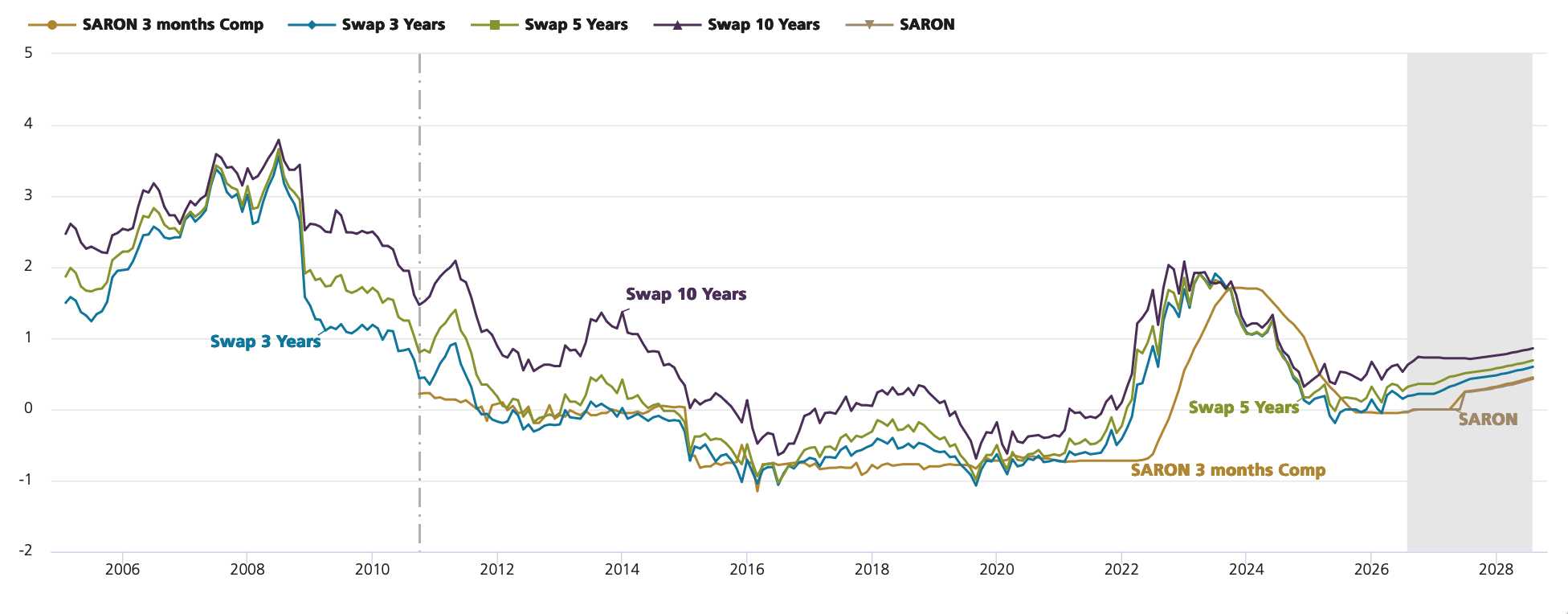
UBS does not expect a clear direction for the coming months, but rather a sideways trend; it is not until 2027 that SARON interest rates could rise again, following an expected economic recovery. According to Wüest Partner, ten-year fixed-rate mortgages currently stand at around 1.9 per cent – which remains an attractive level by historical standards.
Home ownership: A strong 2025 is followed by a slowdown at a high level
Prices for residential property rose significantly once again in 2025: in the fourth quarter, prices for flats were 4.5 per cent higher and those for detached houses as much as 5.3 per cent higher than in the same quarter of the previous year – in both segments above the ten-year average. At the start of 2026, the upward price trend initially continued: In the first quarter, prices for flats were 4.5 per cent higher and those for detached houses 4.3 per cent higher than the previous year’s level.
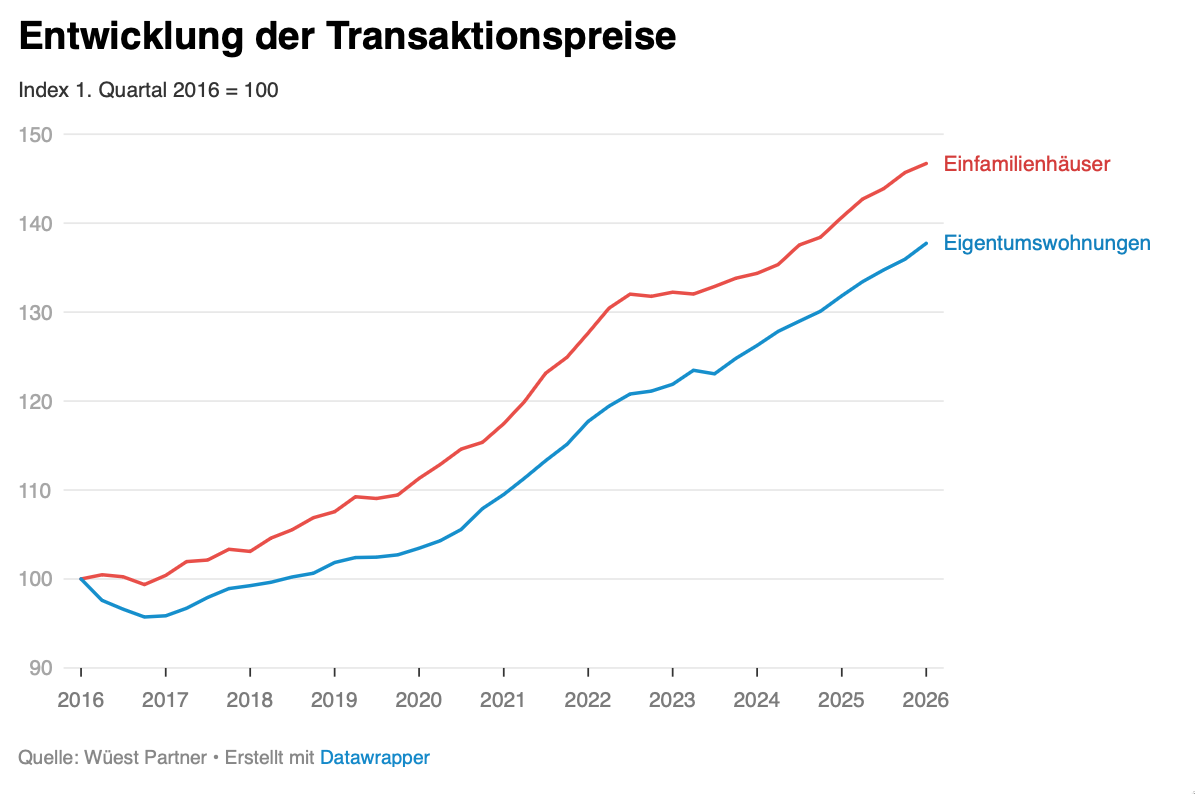
At the same time, the first signs of a slowdown are emerging, particularly for detached houses: Quarter-on-quarter growth in this segment stood at just 0.7 per cent, which was below the rate seen in the previous year. For 2026 as a whole, Wüest Partner expects price rises of around 3.3 per cent for detached houses and 3.5 per cent for flats – a slowdown compared with 2025, but not the end of the upward trend.
Four drivers continue to shape the market
The key drivers of the home ownership market remain largely unchanged. Firstly, persistently low interest rates enable financing on comparatively favourable terms. Secondly, the abolition of the imputed rental value is likely to reduce the tax burden on home ownership for many households and further increase its appeal – a factor that carries particular weight for buyers in the upmarket segment with a correspondingly high imputed rental value. Thirdly, supply remains limited: in the first quarter of 2026, the supply ratio in both segments was below the average for the last ten years. Fourthly, the limited choice and high rent levels in the rental housing market are strengthening the incentive for households with the necessary financial means to move into home ownership.
Why supply remains tight
Recent developments in the construction sector do not point to a short-term expansion of supply. Although nominal investment in the construction of multi-family dwellings rose by an estimated 7.0 per cent in 2025, this figure must be put into perspective: a growing proportion of projects involves replacement new-builds, where existing flats are first demolished, meaning that the net increase in housing supply remains limited. No real momentum in construction is evident for detached houses either, and this is unlikely to change significantly in 2026 – investment is increasingly being channelled into the renovation of existing stock rather than into additional housing. For sellers of existing properties, the market environment therefore remains structurally favourable.
Holiday properties: a market with its own rules
Developments in the second-home sector are particularly relevant to the upmarket segment. The market for holiday properties traditionally outperforms the Swiss average and follows different patterns to the primary residence market: as buyers predominantly finance such properties using their own capital, demand is significantly less sensitive to interest rate fluctuations. This makes holiday homes in attractive locations – such as the Engadin, Valais or Ticino – a comparatively stable asset class that is, to some extent, immune to the general logic of interest rates.
Keeping an eye on the risk of a bubble
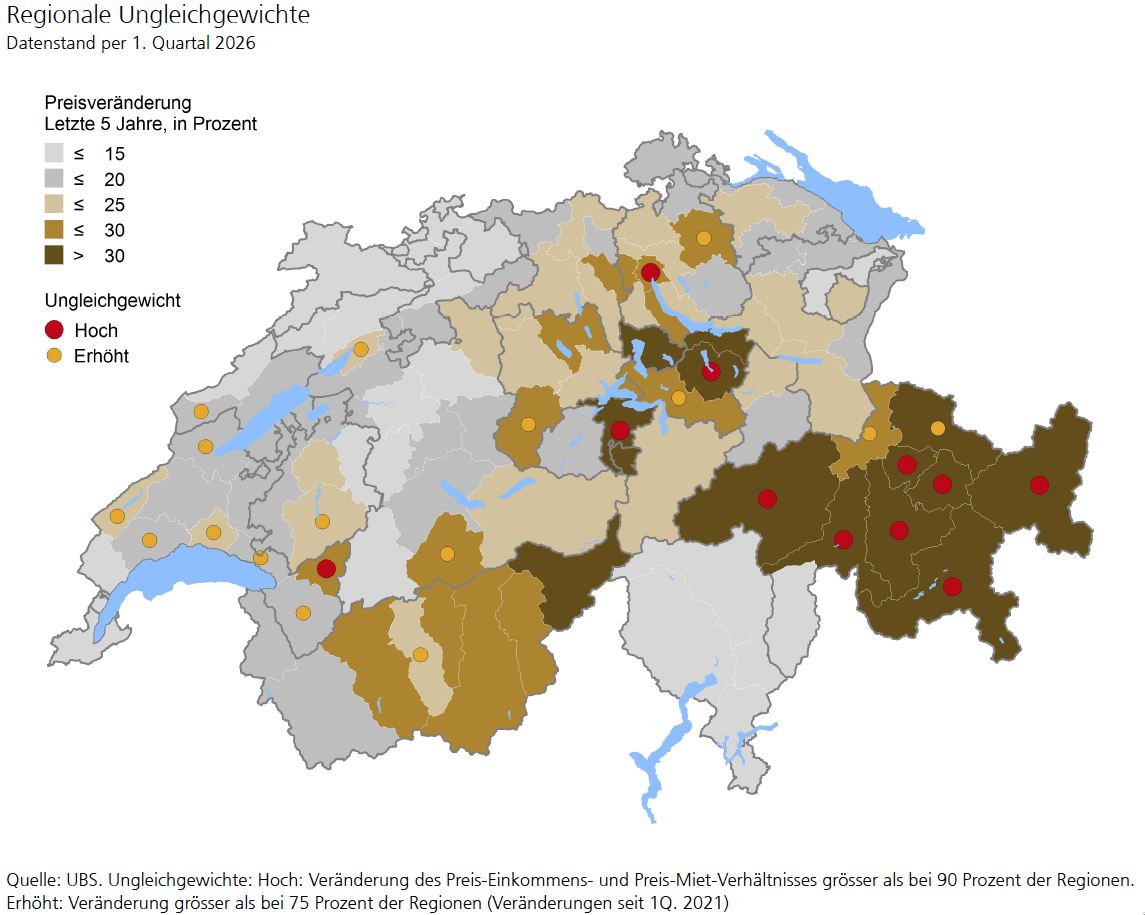
Despite the market’s generally robust condition, it is worth taking a more nuanced view: the UBS Swiss Real Estate Bubble Index has risen noticeably recently and points to a moderate risk of a bubble, which is, however, more pronounced in certain regions – particularly in the tourist regions of Graubünden, as well as in Einsiedeln, the city of Zurich and Nidwalden. For buyers of exclusive properties in these regions, this means that a careful, independent valuation remains essential – even though the current interest rate environment is favourable.
Commercial property: Caution regarding offices, scarcity of retail space
In the office sector, weaker employment trends – particularly in IT and financial services – as well as only moderate growth in 2026 are dampening demand; asking rents are nevertheless expected to rise slightly by around 0.5 per cent. In the case of retail space, the decline in new-build activity over recent years has led to historically low vacancy rates of around 1.8 per cent, whilst ongoing pressure from online retail is likely to cause rents to fall by around 0.8 per cent in 2026.
What this means for buyers
The persistently low interest rates, combined with the prospect of rates remaining stable rather than rising again, continue to favour buying – particularly for buyers with a solid equity base, as is often the case in the upmarket segment. The foreseeable abolition of the imputed rental value is likely to further increase the appeal of home ownership. Anyone wishing to protect themselves against a possible rise in interest rates can use a forward mortgage to fix today’s interest rate up to twelve months in advance. At the same time, in regions with an increased risk of a property bubble, it is worth carrying out a particularly thorough property inspection.
What this means for sellers
For property owners, the market environment in 2026 remains fundamentally favourable: the structurally tight supply – exacerbated by the high proportion of replacement new-builds, which limits the net increase in housing stock – continues to be met by robust demand. Particularly in the second-home market, which is structurally decoupled from interest rate trends, buyers’ willingness to pay remains high. A recent, independent valuation of one’s own property and expert advice from an experienced, well-connected estate agent form the basis for making the most of this environment – especially given the sometimes significant regional differences.