

Gaudí’s “Ghost of New York”.
29.06.2026How an AI artist brought a lost architectural dream to life, creating a hotel that never existed and yet suddenly becomes visible.
Imagine a 360-metre-high sculpture comprising nine towers fused together, right in the heart of Lower Manhattan, crowned by a star-shaped spire and built from iron, stone, mosaics and glass domes. This is precisely what Antoni Gaudí planned in 1908 for two American businessmen: the so-called “Hotel Attraction”. However, this monumental hotel design was never realised. Gaudí’s design consisted of a cluster of nine skyscrapers, which were to reach a height of 360 metres at an unspecified location in Lower Manhattan.
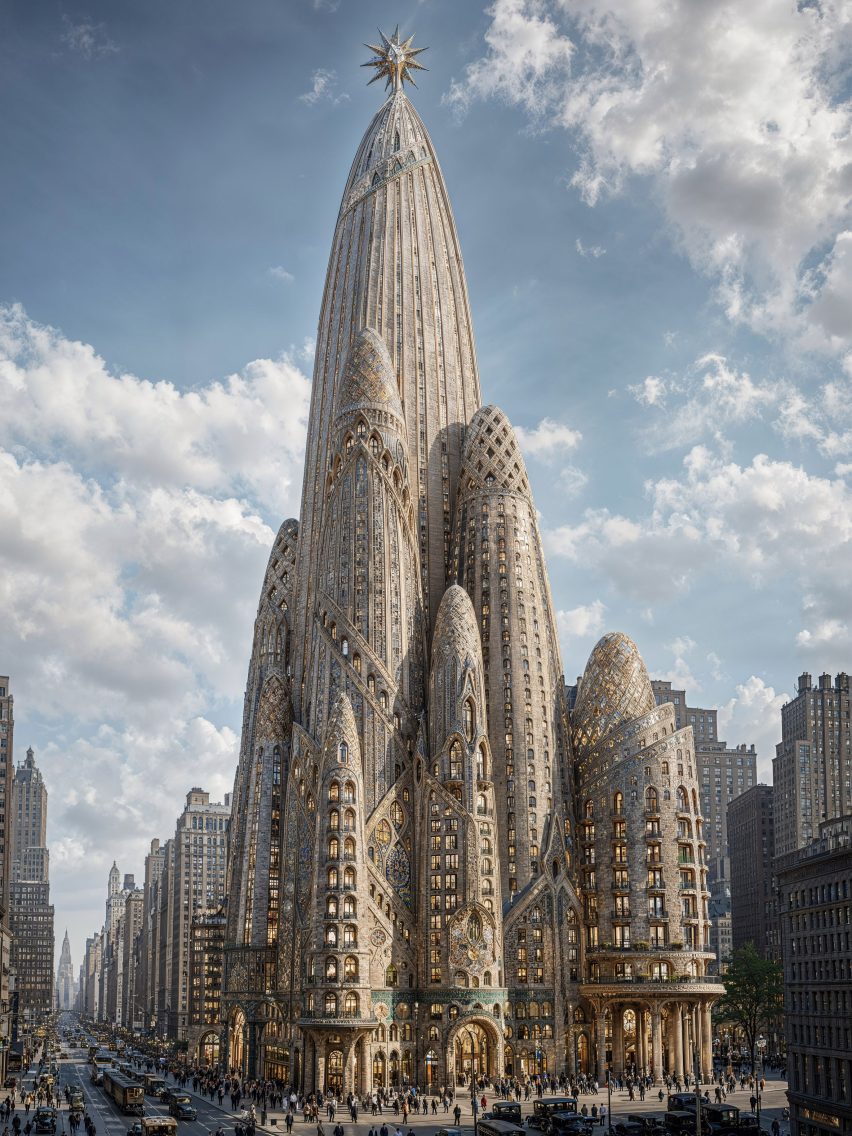
Over a century later, the Belgian AI artist Thierry Lechanteur has digitally resurrected this project, which was never built, to mark the 100th anniversary of Gaudí’s death – thereby sparking an international debate on art, architecture and artificial intelligence that extends far beyond specialist circles and is also of interest to enthusiasts of extraordinary properties and architecture.
The artist: Thierry Lechanteur and “visual fiction”
According to Lechanteur, numerous AI models were involved in the creative process, with him working predominantly with ImagineArt – an AI creative platform offering access to numerous model generators. It is worth noting that the artist has been creating AI-based architectural visualisations since 2022, long before the current wave of generative AI took off. His stated aim is to “create visual fiction, somewhere between photography, architecture, memory and imagination”.
For the Hotel Attraction project, Lechanteur adopted a methodical approach: he drew on historical sketches, written descriptions and academic research, using these to develop a visual narrative that carries forward the spirit of the project, rather than faithfully reproducing a supposedly definitive version. The series of images depicts a soaring central tower, crowned by a star-shaped spire, surrounded by smaller structures that rise like a chiselled mountain range – characteristic Gaudí elements such as organic forms, flowing curves and richly textured surfaces replace the glass-and-steel vocabulary that dominates today’s skyscrapers.
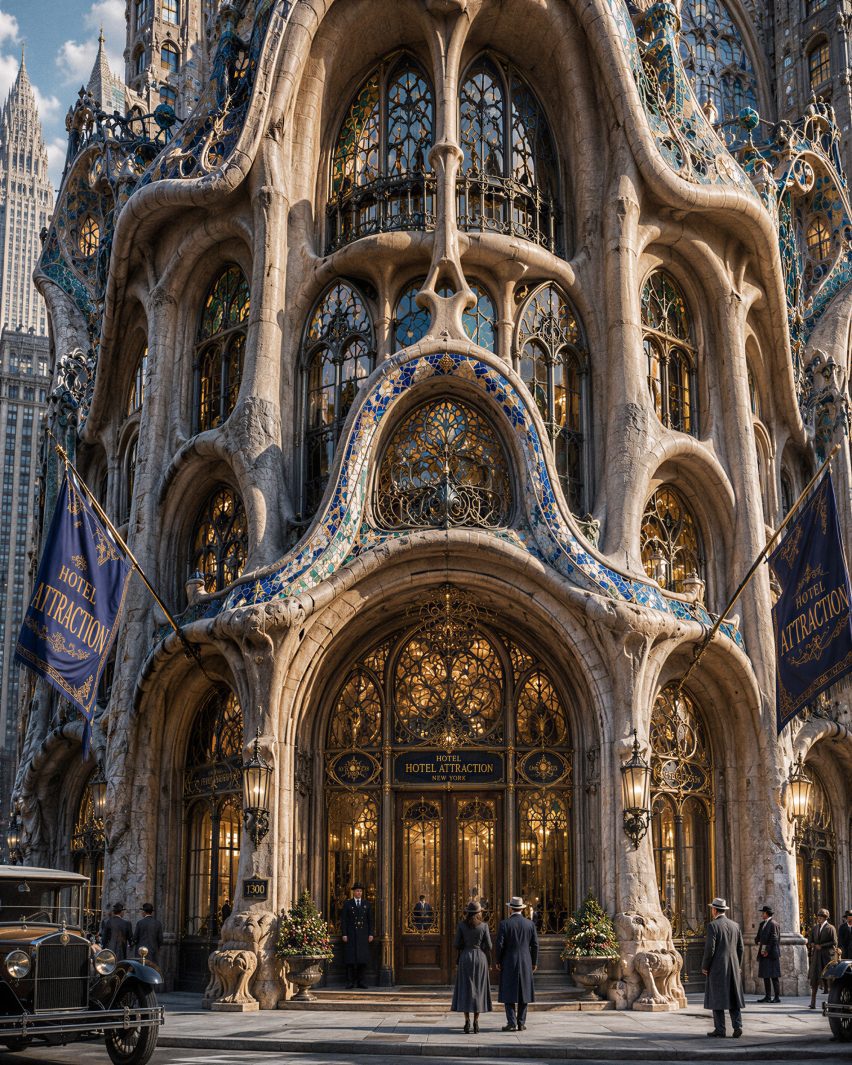
He himself describes his work as an expression of ‘nostalgia for a future that never came to pass’ and explains: People are moved by architecture that “almost existed” – the Hotel Attraction is the “spirit of an alternative New York”, and in a skyline of glass and steel, a 360-metre-high tower of colour and curves seems almost transgressive today, perhaps even more so than in 1908.
The images sparked a mixed reaction online: Some celebrated the fusion of architectural history and AI, whilst others criticised the term “AI artist” on principle – one reader commented that “there is no such thing as an AI artist”, whilst another described the works as “completely pointless”. This controversy shows just how strongly Gaudí’s legacy still stirs emotions, even a century after his death.
The Architect: Antoni Gaudí and his unfinished New York legacy
Antoni Gaudí (1852–1926) is regarded as arguably the most original architect of the modern era and a leading exponent of Catalan Art Nouveau (Modernisme). His life’s work is almost entirely centred on Barcelona, where he created a wholly unique architectural language using organic forms, parabolic arches, ceramic mosaics (trencadís) and a deep inspiration drawn from nature.
The ‘Hotel Attraction’ remained a marginal chapter in his oeuvre for a long time: The designs were virtually unknown until they were published in 1956 by his colleague Joan Matamala i Flotats in the report ‘When the New World Called Gaudí’. The designs were brought to public attention once again in 2003 when they were submitted by a group of art historians as an entry to the international memorial competition for the redevelopment of the World Trade Centre site.
To this day, there are various theories as to why the project failed: some reports suggest that the design was considered too unrealistic; others that Gaudí abandoned the project in 1909 due to ill health; whilst still others suggest that he abandoned it because of his client’s insistence on catering exclusively to an elite clientele. Of interest to architectural historians: decades later, the project resurfaced in specialist discourse when historians proposed it as part of a design concept for the redevelopment of the former World Trade Centre site.
The fact that Dezeen is now featuring the Hotel Attraction as part of an entire “Gaudí Centenary” series – with in-depth research on the Sagrada Família, the Church of Colònia Güell and Casa Batlló, as well as an interview with a senior architect at the Sagrada Família on the “future challenges” involved in its completion – highlights just how much Gaudí’s work is being discussed worldwide in the 100th anniversary year of his death.
Summer tips: Discover Gaudí’s real-life buildings
Anyone who has seen the “spirit” of the Hotel Attraction may be all the more keen to visit the buildings that Gaudí was actually able to realise. For the coming summer holidays, a tour of his real-life legacy is well worth it – most of the highlights are in and around Barcelona, with a few others in northern Spain:
Sagrada Família, Barcelona – Gaudí’s life’s work and still unfinished to this day. The basilica is well worth a visit for its incredible attention to detail: each façade tells its own biblical story, the interior columns mimic a forest, and the light streaming in through the stained-glass windows fundamentally changes the atmosphere depending on the time of day. Be sure to book tickets online, several weeks in advance.
Park Güell, Barcelona – Originally planned as an exclusive garden city for wealthy Barcelonans, today it is a public park featuring the famous mosaic lizard sculpture and the curved bench with trencadís decoration. Well worth a visit for the panoramic view over the city and as a prime example of Gaudí’s fusion of architecture and landscape.
Casa Batlló and Casa Milà (La Pedrera), Barcelona – Two private residences that demonstrate just how radically Gaudí approached even middle-class building projects: undulating façades, skeletal balconies, and a roof at Casa Batlló reminiscent of a dragon’s back. An absolute must-see, especially for lovers of extraordinary residential architecture – here you can see how Gaudí combined functionality and sculpture.
Palau Güell, Barcelona – An earlier, darker masterpiece for his most important patron, Eusebi Güell, featuring a spectacular rooftop garden with a chimney. Less visited than the classics, but quieter and just as impressive.
Colònia Güell, near Barcelona – The crypt-like church in this workers’ housing estate served as an architectural testing ground: it was here that Gaudí developed the suspended chain models he later used to calculate the structural stability of the Sagrada Família. Ideal for a quieter day trip away from the tourist crowds.
El Capricho, Comillas (Cantabria) – One of Gaudí’s few works outside Catalonia: a whimsical summer villa with sunflower-patterned ceramics and a minaret-style tower. For anyone planning a quieter summer trip to Spain’s north coast, it’s a charming addition to any Barcelona itinerary.
Be sure to plan your visits in advance
Be sure to book the Sagrada Família and Park Güell in advance with time-slot tickets, as places are often sold out weeks in advance during the summer. Anyone wishing to visit several sites should allow at least three full days in Barcelona – Gaudí’s work cannot be fully appreciated on a whirlwind tour, but only when you take the time to appreciate the details, the light and the materials.
It is precisely this real, built substance that makes the appeal of Lechanteur’s digital “ghost architecture” tangible: it shows what Gaudí could have created – and at the same time makes it all the more clear what an extraordinary legacy he has actually left behind.